Agentic paperwork, inside a harness.
A model on its own writes paperwork that sounds right. Jubal Med puts the model inside a harness: the rules, gates and second opinions that decide what is allowed to reach your team. The model does the reading and the drafting. The harness decides what passes. Your team decides what's true.
The same model, with and without a harness.
On its own: Fills gaps with what is likely.
In the harness: Reads every record through its tools. A fact the records don't hold is asked for, or listed under Missing.
On its own: Cites what it remembers, which may be out of date or invented.
In the harness: May cite only text it retrieved from the corpus in that same run. Anything else is refused before you see it.
On its own: Formats it however it likes.
In the harness: Each statutory form's anatomy is written in code. A draft missing a required part can't be finalized.
On its own: Grades its own work.
In the harness: A second model, from a different vendor on purpose, audits every draft.
On its own: Sounds sure, either way.
In the harness: Proposes. Your IDG decides, disputes go to physician review, and the physician signs.
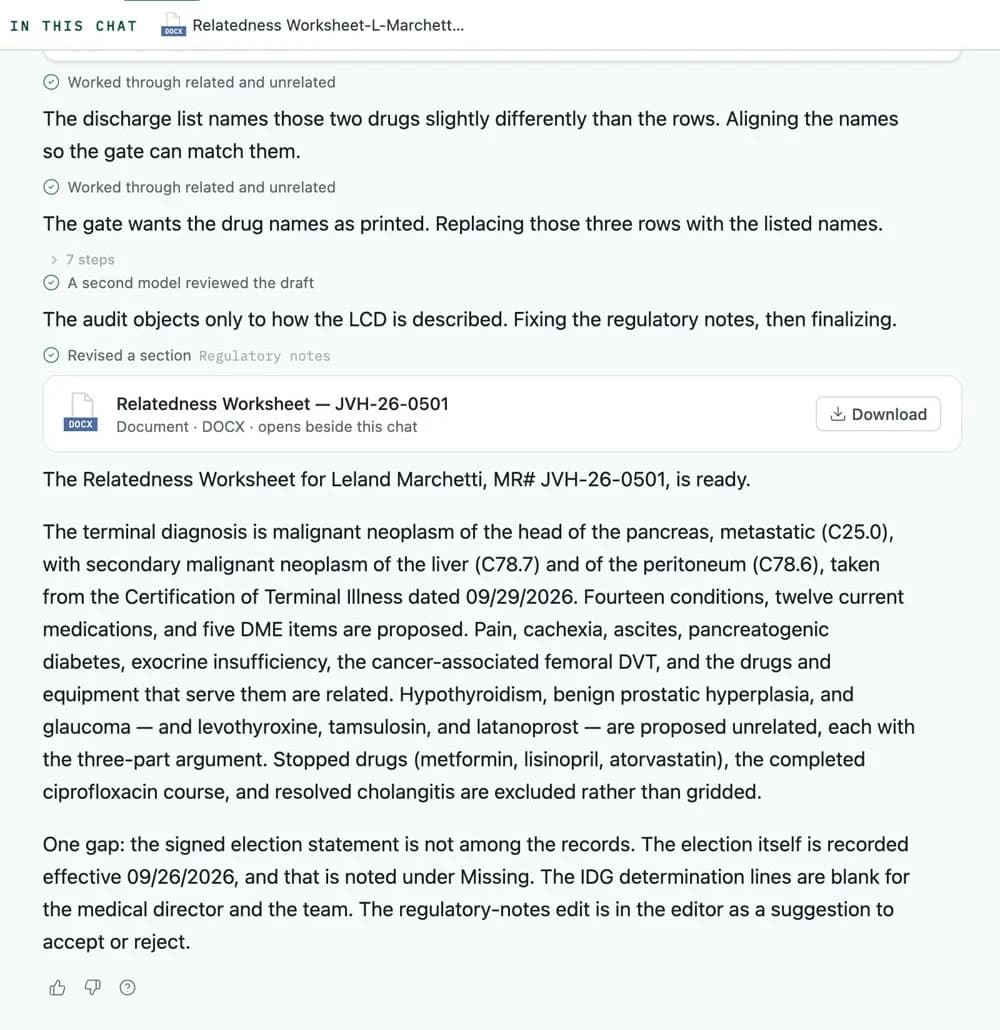
One relatedness worksheet, from records to signature.
The steps run on their own, in minutes. When a check refuses the draft, the run fixes it and tries again, and tells you what it changed.
- 1ReadEvery record on the patient, and the governing text: 42 C.F.R. § 418.24, CMS manuals, your contractor's LCDs.
- 2DraftTo the form's rules for your hospice, served fresh each run, so a rule change reaches every desk at once.
- 3GateCode checks the draft: cites retrieved, form complete, every listed item a row, LCDs that bind your state. A refusal goes back to step 2.
- 4AuditA model from another vendor reviews the draft against the records and the rule. Its objections are fixed or left for people.
- 5Your teamReviews, changes what it disagrees with, and signs. The addendum is built from the signed worksheet.
Enforced in code, not asked for in a prompt.
An instruction can be ignored. A check that refuses to finalize can't. These run on every draft, whichever model wrote it, and run again on our servers before a document can be finalized.
The citation gate
A cite appears only if its text was retrieved in that conversation, with its source, retrieval time and the dates it was in force.
The form's anatomy
The addendum, the certification and the worksheet each have their required parts in code. Missing one, the draft can't be finalized.
Every item a row
Each listed diagnosis, medication and supply becomes a row, or is left off for an allowed reason. Every row must be on a list.
Your contractor, by state
Your hospice's state sets its Medicare contractor. An LCD that doesn't bind your state can't be cited on your forms.
Last time, remembered
A new worksheet starts from the last signed one. A related call that flips to unrelated, or back, goes to physician review.
The clinical line
Questions about whether a patient is eligible, or their prognosis, are declined. It cites the process and the documentation instead.
See the harness work on your own admission.
14-day free trial, no card. Every request is read and approved by a person.