From the referral packet to the signed record.
Six verbs cover the work: admit the patient from the documents, track every clock, determine relatedness, draft the statutory documents, ask the regulatory questions, and respond to what lands on your desk. In each one Jubal Med does the reading, listing and typing, and your team does the reviewing — and any regulatory claim is retrieved, quoted and dated, never recalled.
Admit
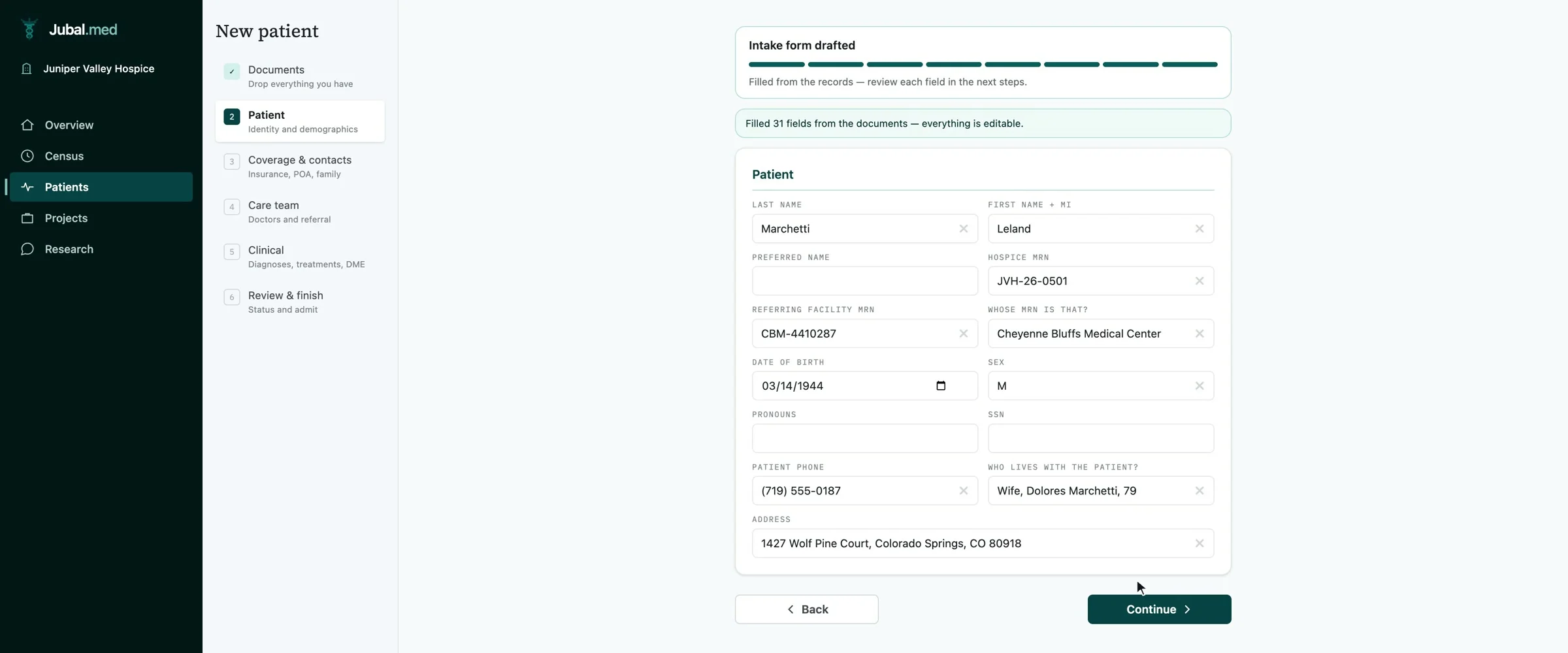
The referral packet becomes the patient, in minutes, without re-keying.
A referral arrives as a stack: a face sheet, an H&P, a discharge medication list, your own intake notes. Drop them all on the new-patient screen. Jubal Med reads every page, names the document it is on, and fills the form — demographics, MBI, terminal diagnosis, attending, contacts, code status, location of care. Where the chart is silent it asks, with a skip, instead of guessing.
- A patient pre-filled from the documents, with the source of each fact on the record
- PDFs, Word files, scans and whole folders — scanned pages are read too
- Questions where the chart is silent; a skipped answer is listed as missing, never invented
- An unfinished intake is kept, resumes where it left off, and only a person deletes it
Track
Every regulatory clock, from the election date, on one card.
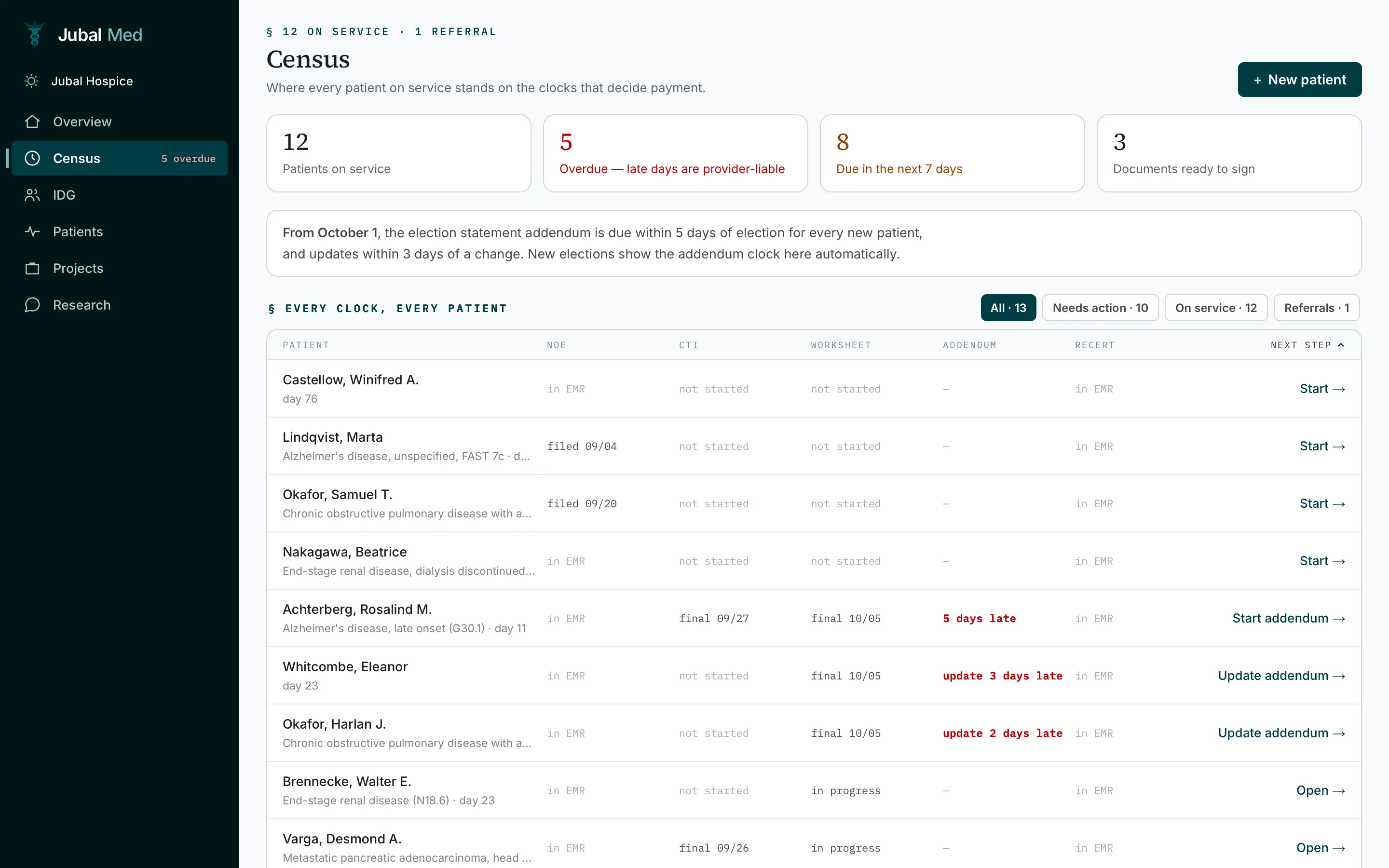
Record the election and the clocks start: the Notice of Election to the MAC, the election statement addendum, recertification for each benefit period, the face-to-face before the third, and the HOPE assessment windows. The census leads each patient with the one deadline that matters next, and the tiles count what is due across the whole service.
- NOE, addendum, recertification and face-to-face clocks computed from the election date
- HOPE admission, HUV1 and HUV2 windows and the admission record's submission deadline
- A census sorted by next deadline, with overdue and due-soon at a glance
- Your organization's own compliance items, spawned as tasks at admission
Determine
Related or unrelated, for every diagnosis, medication and supply — proposed, reasoned, and yours to decide.
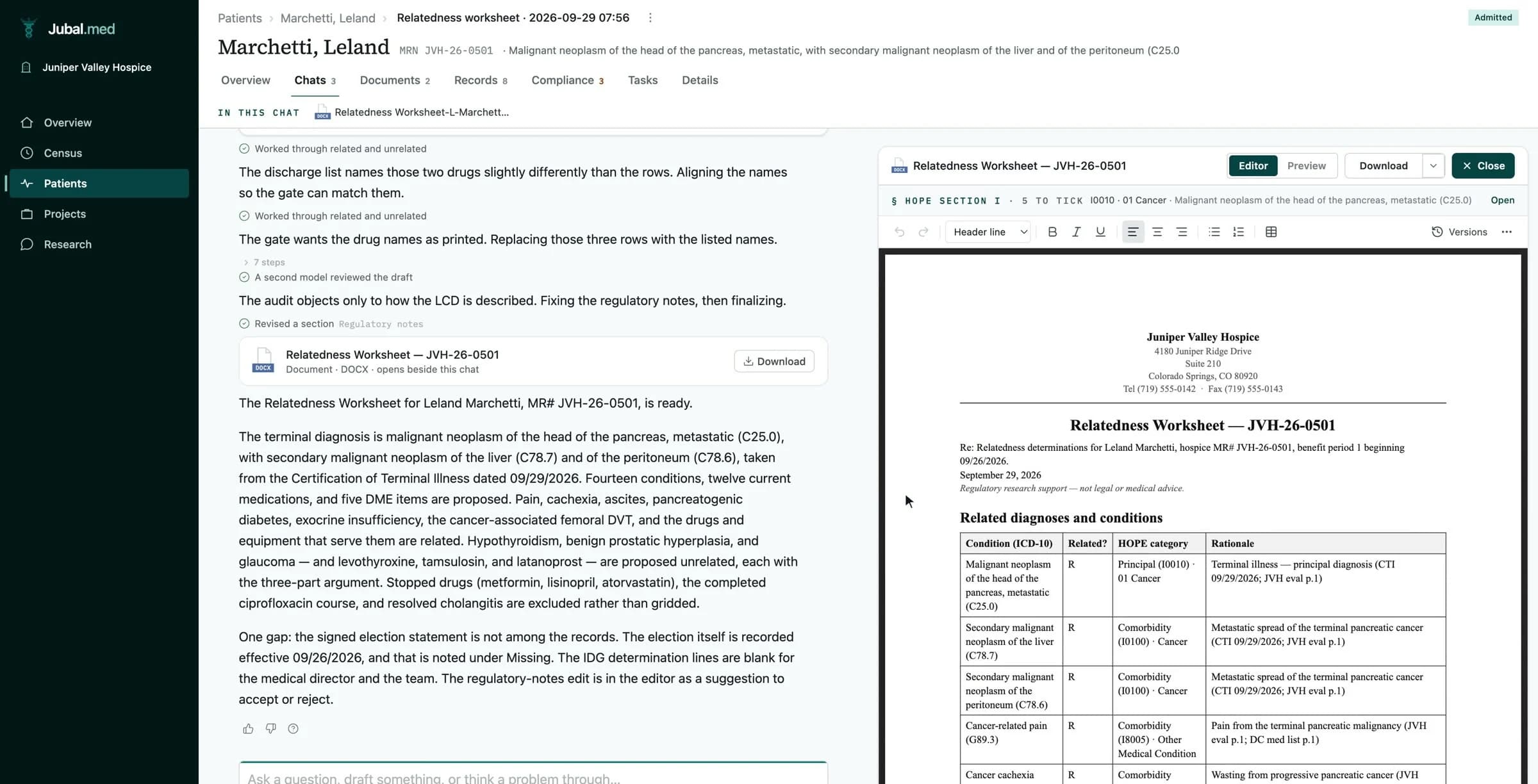
The relatedness worksheet reads the whole chart and proposes a determination in every row: related, unrelated, or physician review for the genuine close calls. Each unrelated row carries the three-part rationale the regulation expects, with the chart page it came from. A medication follows the condition it serves, so the grids cannot contradict each other. Beside each diagnosis sits the HOPE Section I item for the admission assessment.
- Three locked grids — conditions with ICD-10-CM codes, medications, DME and supplies
- A rationale and a chart cite in every row; nothing blank “for the team”
- Completeness checked against the record's own medication and problem lists
- HOPE Section I items proposed from the ICD-10 code, with a review flag where a clinician must decide
Draft
The statutory documents, built from the record and checked before you see them.
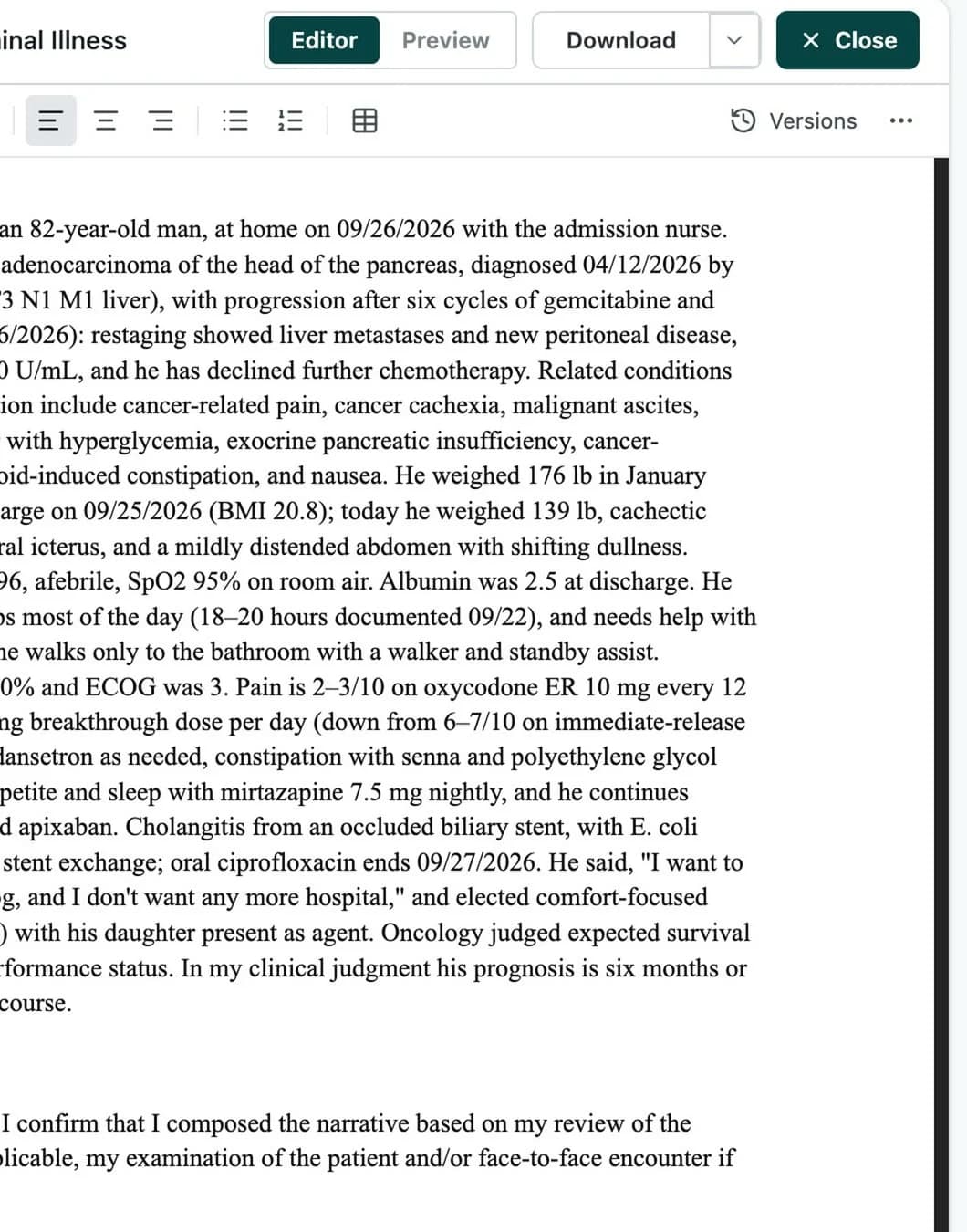
The election statement addendum is built from the finalized worksheet's unrelated items, with a plain-language reason per item. The certification of terminal illness drafts for the medical director's signature. Form anatomy is set by statute, so it is enforced in code: a document that breaks its form's rules is refused, not shipped. A second model from a different vendor audits every draft first.
- Election statement addendum, certification of terminal illness, NOE filing worksheet
- A form gate that refuses a non-conforming document at finalize — the spec is never loosened to pass one
- A cross-vendor audit pass on every draft, with its findings on the record
- A live team document: edit together, keep versions, download as Word or PDF
Ask
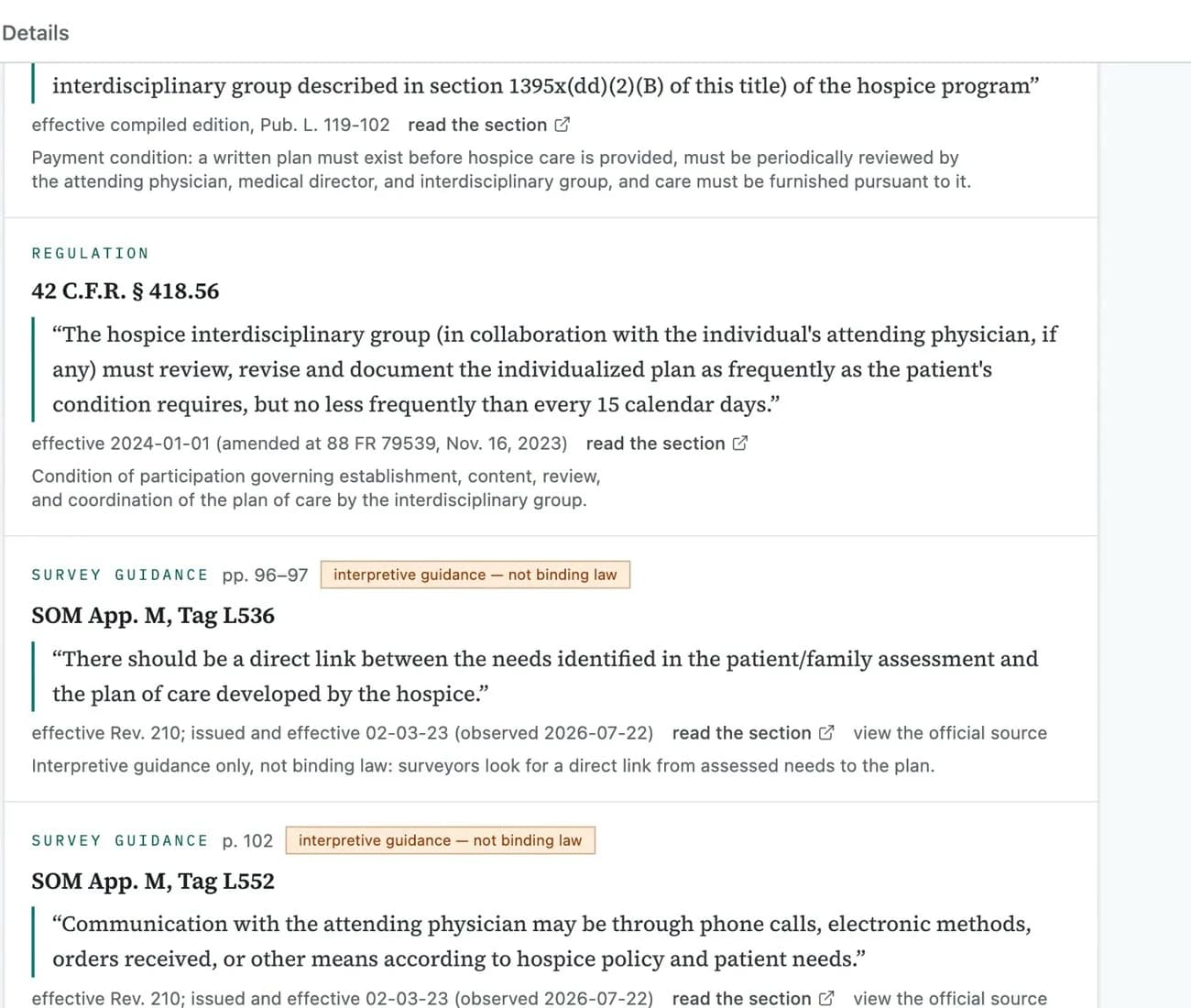
Regulatory questions, answered the way you need to rely on them — as written, cited, defensible.
A surveyor cites you under a condition of participation, or a facility asserts a requirement you don't recognize. Ask exactly that, in the words you'd use with a colleague — Jubal Med translates it into the corpus's terms of art, reads the full section text, and answers from what it retrieved. Ask inside a patient and it answers with that patient's records on hand.
- The full authority stack on one card: statute, regulation, and survey guidance, each quoted verbatim
- Effective and amendment dates on every cite, with links back to the official source
- Survey guidance always badged as interpretive — never presented as binding law
- A plain “not on file” when the controlling authority isn’t in the corpus — never a guessed cite
Respond
The documents that land on your desk, taken apart claim by claim, and answered.
A deficiency statement arrives from a survey, or a payer denial cites chapter and verse against you. Open a project, drop the document in, and Jubal Med identifies each regulatory claim inside, researches what the cited text actually says, and drafts the response as a cited memo your team edits together.
- Every asserted requirement checked against the current text of the authority it cites
- Claims the text doesn’t support, surfaced with the language that shows it
- Cited memos in .docx, ready for a plan of correction, a facility, or the other side
- Projects hold the files, the chats and the drafts in one place, shared with your team
Run your next admission through it, and see the addendum on day one.
14-day free trial, no card. Every request is read and approved by a person.