For six years the election statement addendum was a form most hospices rarely had to produce. A patient or family had to ask for it, and very few did. That ended on October 1. For every election that begins on or after that date, the hospice must hand the patient a written addendum within the first five days, whether or not anyone asks.
The form itself is one page and not hard to fill in. What is hard is what has to be true before you can fill it in: someone has read the whole chart, made a relatedness call on every condition, medication and piece of equipment, and written down why. The addendum is only the visible end of that work, and the work now has a five-day clock on it for every patient.
This post covers what the rule says, where it tends to go wrong, a worked example on a fictional patient, and how Jubal Med helps.
What changed on October 1
The addendum's title and contents are the same as before. Its timing and who gets it are what changed.
An election that began before October 1 stays under the old rule: the addendum is furnished when the patient asks for it.
CMS was direct about why it made the change. Medicare spending outside the hospice benefit, for patients who have elected hospice, has kept growing. In the final rule CMS wrote that the framework in which the addendum "is provided only upon request, has not achieved the intended accountability objective of ensuring that hospices provide virtually all care needed by terminally ill individuals."
That phrase, "virtually all," is the standard behind the whole rule. The election statement already has to tell the patient that services unrelated to the terminal illness are "exceptional and unusual" (§ 418.24(b)(3)). The addendum is where a hospice now has to name each exception and explain it, for every patient.
One more reason to take it seriously: Medicare covers hospice care only when the patient has elected it "in accordance with § 418.24" (§ 418.200), and the addendum is part of that section.
The form is the last step, not the first
Read what the addendum must contain and the real work shows through. It must list the patient's conditions present on admission and the items, services and drugs the hospice will not cover because it has determined them unrelated. For each one it must give:
A written clinical explanation, in language the individual (or representative) can understand, as to why the identified conditions, items, services, and drugs are considered unrelated to the individual's terminal illness and related conditions and not needed for pain or symptom management.
So before the form there is a relatedness determination, and it has to hold up. In practice that means four things, all inside five days:
- The whole chart is read. The hospital's discharge list, the oncology consult, the hospice admission evaluation. A medication that appears on one list and not another still needs a call.
- Every item gets a call. Related, unrelated, or a genuine close call for the physician.
- Every unrelated call has a reason. What the drug treats, why that condition is separate from the terminal illness, and why the treatment is not for comfort or symptom control.
- The reason is written twice. Once for the clinical record, once in words the patient's family will understand.
The places it goes wrong are predictable:
- A drug on the hospital's discharge list never makes it onto the hospice's list, so nobody decides it.
- A row says "unrelated" and gives the diagnosis as the reason. A diagnosis is not a reason.
- The explanation is written for a nurse: "chronic comorbidity with independent etiology." CMS addressed this in the final rule: the plain-language requirement "is not a suggestion, it is a regulatory requirement."
- A patient with nothing unrelated gets no addendum at all.
- A determination changes three weeks in and the addendum on file is never updated.
A worked example
Leland Marchetti elects hospice with metastatic cancer of the head of the pancreas, spread to the liver and the lining of the abdomen. The hospital sent eight records: a referral and face sheet, a history and physical, a CT, oncology and palliative care consults, a discharge summary, a discharge medication list, and the hospice's own admission evaluation. Between them they list more than a dozen conditions, a dozen current medications and five pieces of equipment.
Here is how the calls come out.
| Condition and what treats it | Call | Why |
|---|---|---|
| Cancer pain · oxycodone | Related | Pain from the terminal cancer |
| Weight loss and wasting · mirtazapine | Related | Wasting from the advancing cancer |
| Fluid in the abdomen | Related | Caused by the cancer's spread |
| Diabetes · insulin glargine | Related | The cancer damaged the pancreas and caused the diabetes |
| Poor digestion · pancrelipase | Related | The pancreas no longer makes enough enzymes |
| Blood clot in the leg · apixaban | Related | A clot brought on by the cancer |
| Constipation, nausea · senna, ondansetron | Related | Symptoms of the illness and of its pain treatment |
| Hospital bed, wheelchair, commode, shower chair, walker | Related | Equipment follows the condition it serves |
| Underactive thyroid · levothyroxine | Unrelated | A separate, long-standing condition |
| Enlarged prostate · tamsulosin | Unrelated | A separate, long-standing condition |
| Glaucoma · latanoprost eye drops | Unrelated | A separate, long-standing condition |
Three things in that table are worth a second look.
The diabetes is related. A checklist would put diabetes with the thyroid and the prostate: a chronic condition the patient had anyway. In this chart the records say the diabetes came from the pancreatic cancer. It belongs to the terminal illness, and the hospice covers the insulin. The same is true of the blood clot. You only find this by reading the records, not the problem list.
Some items are left off, and the worksheet says why. The chart also lists metformin, lisinopril and atorvastatin, all stopped at discharge, and an infection of the bile ducts that resolved, with an antibiotic course that has ended. None of them gets a determination, because nothing is being given. Each is listed with its reason, so a reviewer can see it was considered and not missed.
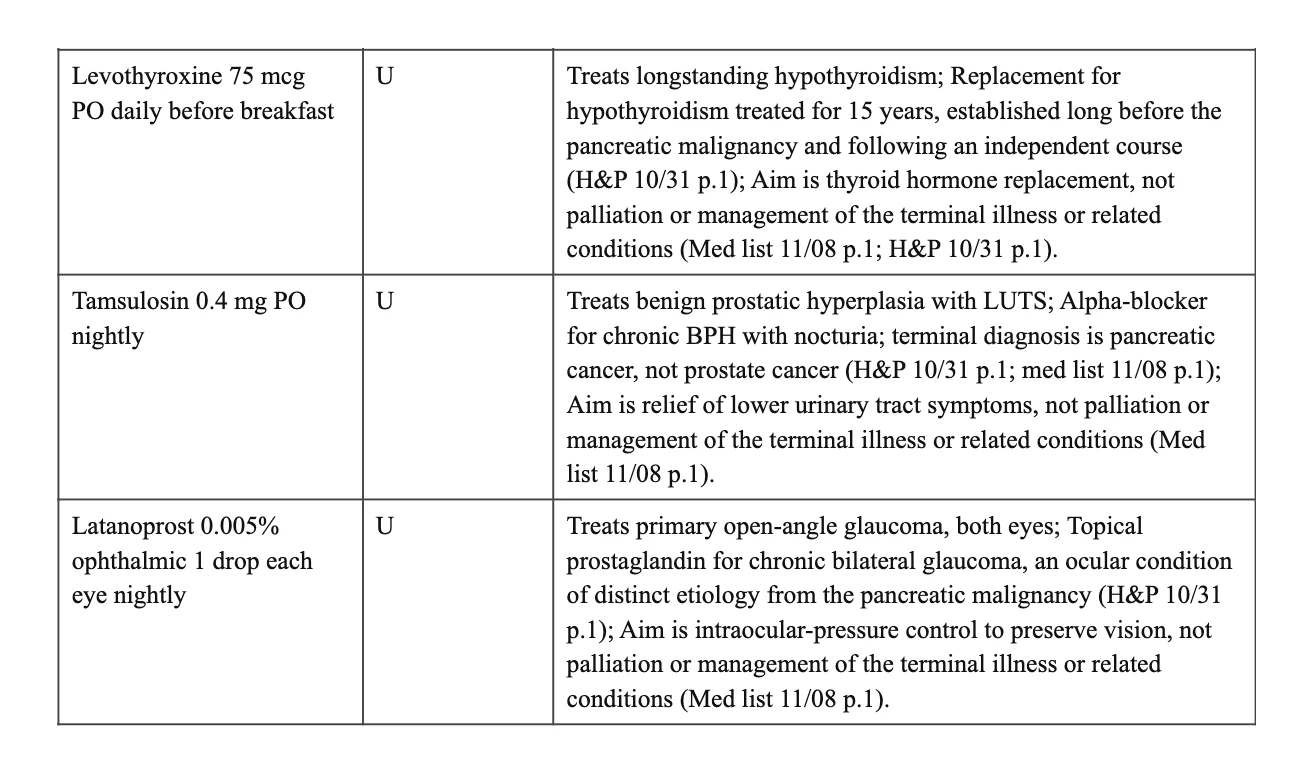
Each unrelated call carries its full reason. This is the levothyroxine row as the worksheet states it, for the clinical record:
Treats longstanding hypothyroidism; Replacement for hypothyroidism treated for 15 years, established long before the pancreatic malignancy and following an independent course (H&P 10/31 p.1); Aim is thyroid hormone replacement, not palliation or management of the terminal illness or related conditions (Med list 11/08 p.1; H&P 10/31 p.1).
It says what the drug treats, why that condition is separate from the terminal illness, and why the treatment is not comfort care, and it names the record and page for each.
And this is the same call as it appears on the addendum the family receives:
This medicine treats the underactive thyroid. Your October 31 hospital history says you have taken it for 15 years, long before the pancreatic cancer, and the November 8 medicine list continues it. That thyroid problem follows its own course. Those records do not tie it to the cancer or to the weight loss from the cancer. The medicine replaces thyroid hormone. It is not used for comfort care of the pancreatic cancer or the related conditions.
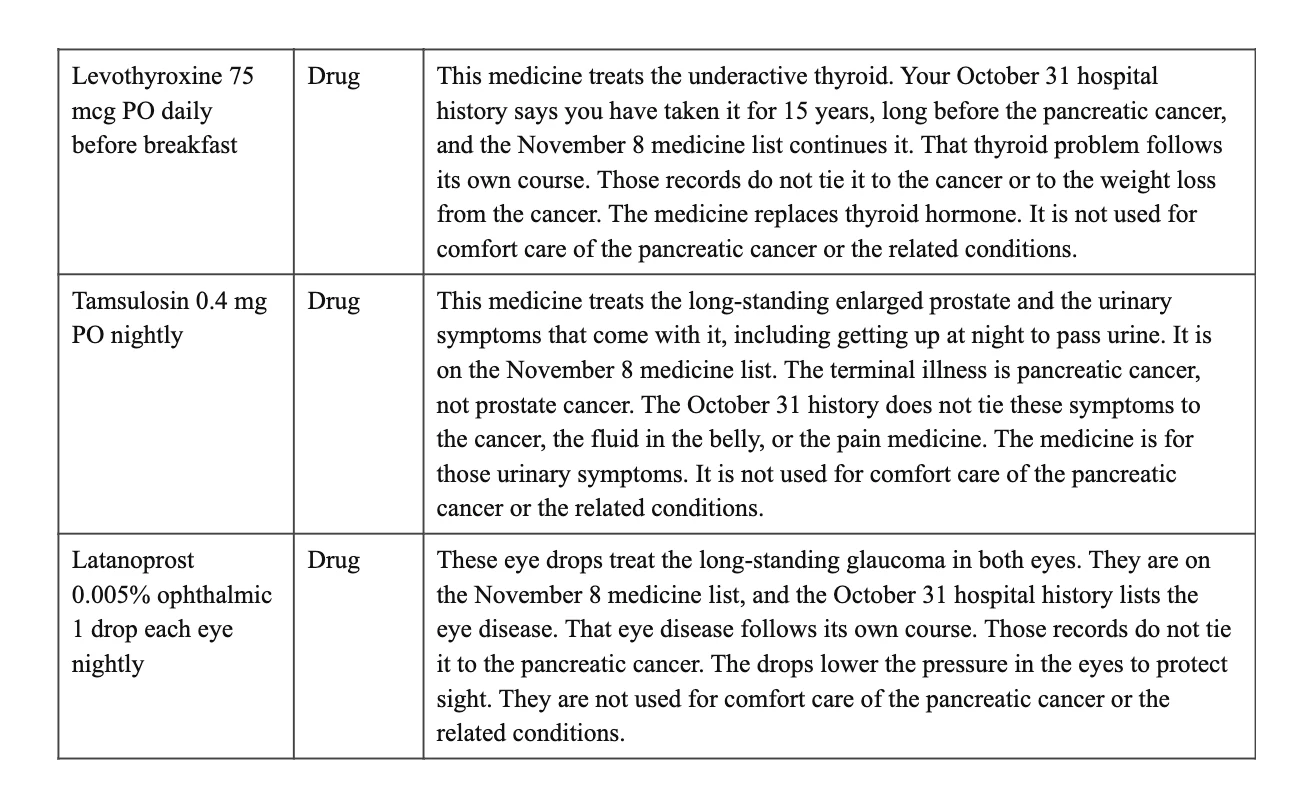
The clinical determination is the same in both. Only the second is written for the person who has to act on it.
What Jubal Med does with those five days
Jubal Med does the reading and the drafting. Your team makes the decisions.
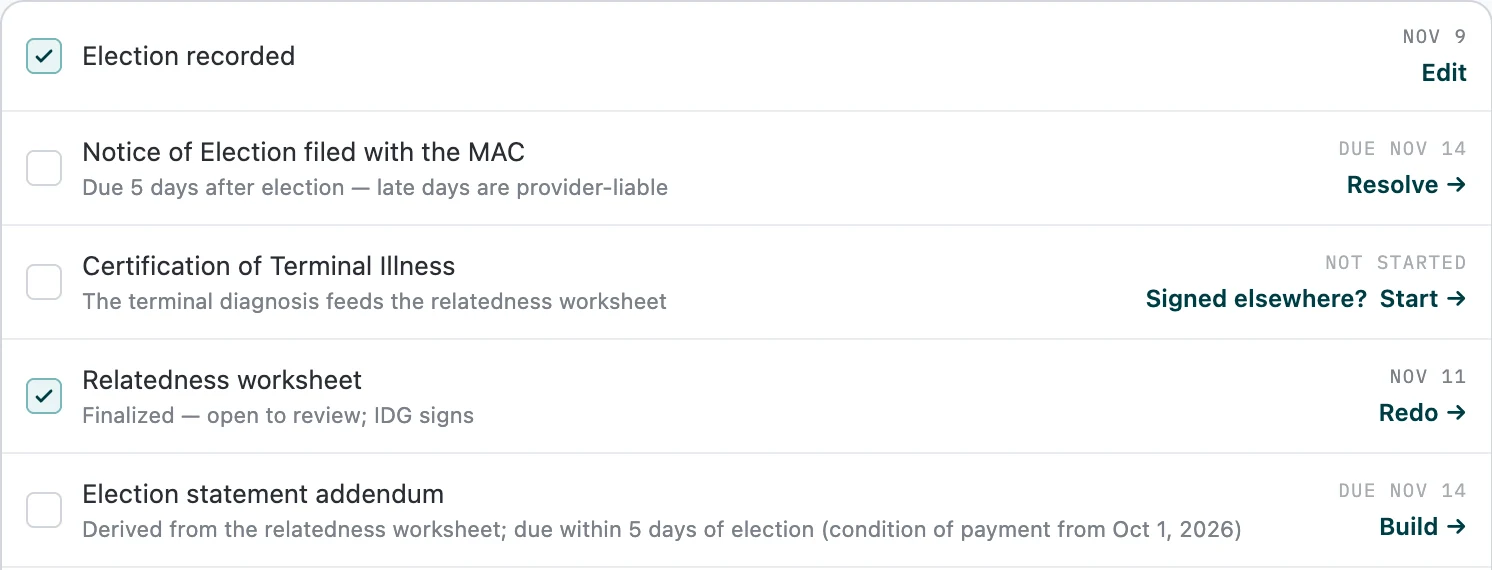
- The clock starts with the election. Record the election and the addendum appears on the patient's compliance list with its due date, next to the Notice of Election, which is due in the same five days.
- The worksheet is drafted from every record. Each diagnosis, medication and piece of equipment on the chart gets a row, or is left off for a stated reason. Each row proposes related, unrelated or physician review, with the record and page it rests on. Unrelated rows carry the full three-part reason. The regulatory notes cite only the LCDs that bind your hospice's state.
- A second model checks the first. A model from a different company audits every determination. What it objects to is fixed from the record, or sent to physician review. Nothing in dispute is quietly decided.
- Your IDG decides. The team reads the rows, changes what it disagrees with, and signs. A row marked for physician review stays off the addendum until the physician has made the call.
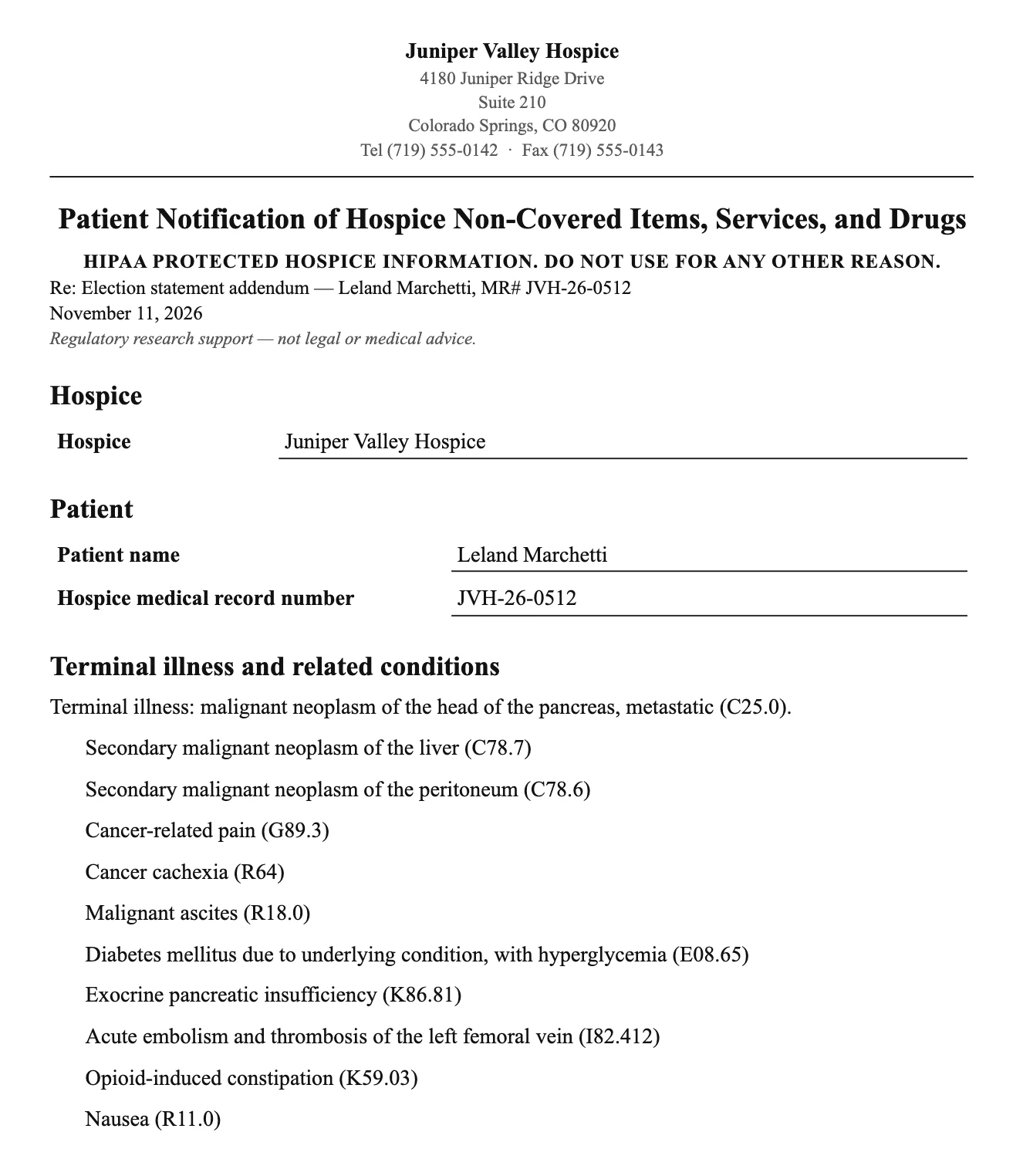
- The addendum is built from the signed worksheet. One row for each unrelated determination, nothing added, nothing dropped and nothing decided again. It carries every element § 418.24(c) requires: the title, the hospice, the patient, the terminal illness and related conditions, the plain-language explanations, the references, the purpose statement, the right to immediate advocacy through the BFCC-QIO, and the acknowledgment lines. It is checked for clinical shorthand before it can be finalized, and it downloads as a Word file.
- Changes restart the clock. When a later worksheet changes a determination, the compliance list shows the addendum as needing an update and counts the three days.
What Jubal Med does not do is decide. Whether a condition is related is a clinical judgment that belongs to your physician and your IDG. The worksheet is a proposal with its reasons showing, built so that agreeing or disagreeing with a row takes seconds.
Two more cases worth knowing
A patient with end-stage heart failure takes eight medications, and the team determines that every one of them is related. There is nothing to list. The addendum is still required. It states that the hospice reviewed the conditions present on admission and determined that all of the patient's care is related and covered.
CMS answered this directly when hospices asked whether such a form was pointless: an all-related addendum "is not a blank form; it is a meaningful clinical record that confirms the hospice conducted the required individualized assessment."
Three weeks after admission a patient has a flare of gout and starts allopurinol. Gout that flares during a terminal illness is a real close call, so the worksheet sends it to physician review. The medical director decides it is unrelated and the plan of care is updated. The hospice now has three days to update the addendum, give the update to the patient in writing, and replace the copy on file. The patient's signature on the update, like the first, only acknowledges receipt.
Before your next admission
A short list to check your own process against, whatever tools you use:
- Know your day five. It counts from the election's effective date, the same as the Notice of Election.
- Name who owns relatedness. Someone has to read the outside records, not only the hospice's own medication list.
- Read one explanation aloud. Take an unrelated explanation from a recent addendum and read it as if to the patient's daughter. If she would have to look up a word, rewrite it.
- Have an answer for "all related." That patient still gets an addendum.
- Decide what triggers an update. A plan-of-care change that affects a determination starts a three-day clock. Know who notices and who updates the form.
- File it with the election statement. Non-hospice providers and your Medicare contractor are entitled to it.
If you would like to see this run on a chart, the relatedness page shows the worksheet and the addendum in the product.
This post is general information about a Medicare rule, not legal advice. The rule itself is 42 C.F.R. § 418.24, as amended by 91 FR 49118.