A hospice admission is one event for the family and a list of deadlines for the hospice. Most of them count from the same day, several fall due in the same week, and they are written down in different places: the payment rules, the conditions of participation, and the quality reporting manual. A small team keeps them in a spreadsheet, a whiteboard, or one person's head.
This post puts them on one page. For each clock: what starts it, when it is due, where the rule is, and what happens when it is missed. At the end there is one fictional patient with every date worked out.
Day zero is the election's effective date
Almost everything below counts from the effective date of the election, not from the referral, the first visit, or the day the paperwork was signed. If those dates differ in your records, the clocks follow the effective date. Getting that one date right matters more than anything else on this page, because every other date is arithmetic from it.
The second thing to know is the shape of the benefit. Hospice care is elected in periods: two of 90 days, then any number of 60 days (§ 418.21). The later clocks, recertification and the face-to-face encounter, count from where those periods begin and end. A patient who transfers in or re-elects does not start again at period one.
The first five days
Five things are due in the first five days, and they belong to different people.
The Notice of Election is the one with a price printed in the regulation. When it is filed late, Medicare "will not cover and pay for days of hospice care from the effective date of election to the date of filing of the notice of election. These days are a provider liability, and the provider may not bill the beneficiary for them." A notice filed on day nine costs the hospice nine days of care it has already given. CMS may waive that for exceptional circumstances, such as a disaster or a contractor systems problem, but the hospice has to document it and ask.
The addendum is the newest clock on the list. We wrote about it at length in the October 1 rule. The short version: it cannot be filled in until someone has made a relatedness call on every condition, medication and piece of equipment, so the five days are really five days for that work.
The certification
Alongside the first five days runs the certification of terminal illness (§ 418.22).
- Two calendar days for the certification. If the hospice cannot get the written certification within 2 calendar days after a period begins, it must get an oral certification within those 2 days.
- Written before the claim. The written certification must be on file before the hospice submits a claim for payment.
- No more than 15 days early. A certification may be completed no more than 15 calendar days before the effective date of the election, and a recertification no more than 15 calendar days before the next period begins.
The two-day rule is the one that slips on a Friday admission. An oral certification taken by phone on Saturday keeps the period covered; a written one that arrives the following Wednesday, with nothing oral before it, does not.
Every 15 days
Two conditions of participation set a repeating clock, and in practice they are met at the same meeting.
- The assessment is updated "as frequently as the condition of the patient requires, but no less frequently than every 15 days" (§ 418.54(d)).
- The plan of care is reviewed by the interdisciplinary group "as frequently as the patient's condition requires, but no less frequently than every 15 calendar days" (§ 418.56(d)).
This clock never finishes. It restarts at each review for as long as the patient is on service. It is also the one a surveyor can check on any chart on any day: count the days between documented reviews, and a gap of sixteen is a finding. A team that meets every two weeks has one day of slack, and a holiday week uses it.
HOPE
Since October 2025 the Hospice Outcomes and Patient Evaluation tool has replaced the old Hospice Item Set, and it brought visit windows with it. From the HOPE Guidance Manual:
| Timepoint | When |
|---|---|
| Admission assessment | No later than 5 calendar days after the effective date of the election |
| Update Visit 1 | On or between day 6 and day 15 |
| Update Visit 2 | On or between day 16 and day 30 |
| Admission record | Completion goal: admission date plus 14 days. Submission deadline: admission date plus 30 days |
The update visits are windows, not deadlines. A visit on day 5 does not count as Update Visit 1, and neither does one on day 16. Late or missing records count against the hospice's quality reporting, and a hospice that falls short of the reporting requirement takes a reduction to its annual payment update.
At the end of each period
Two clocks belong to the period boundary, not the admission.
For a patient who starts at period one, the third period begins on day 181. The face-to-face window opens 30 days before that. It is a window with two edges: an encounter 35 days ahead is too early, and one after the period has begun is too late. A hospice that misses the window cannot recertify on time.
The count is across all hospices. A patient who transfers to you in their third period needs an encounter even though it is their first week with you.
One patient, every date
Rosa Marchetti elects hospice with an effective date of November 9. She has not had hospice care before, so this is benefit period one.
| Clock | Due |
|---|---|
| Initial assessment | November 11 (48 hours) |
| Certification, oral or written | November 11 |
| Notice of Election filed | November 14 |
| Election statement addendum | November 14 |
| Comprehensive assessment | November 14 |
| HOPE Admission assessment | November 14 |
| First 15-day review | November 24 |
| HOPE Update Visit 1 | November 15 to 24 |
| HOPE Update Visit 2 | November 25 to December 9 |
| HOPE Admission record submitted | December 9 (goal: November 23) |
| Period one ends | February 6, 2027 |
| Recertification for period two | January 23 to February 6, 2027 |
| Period two ends | May 7, 2027 |
| Face-to-face before period three | April 8 to May 7, 2027 |
| Recertification for period three | April 23 to May 7, 2027 |
Notice how much of that table sits in the first week. November 14 is a Saturday, and four things are due on it. A team that plans to finish on day five is planning to finish them on a weekend.
How Jubal Med keeps them
Jubal Med works these dates out from the election, so nobody types them in.
- Record the election and the list appears. Each patient has a compliance list with the clocks Jubal Med tracks, each with its due date, and whether it is done, due soon or overdue.
- A clock that comes due adds its own task. The task goes to the RN case manager when one is named, closes itself when the clock is met, and sends a reminder only if the person has task email turned on.
- Late is counted where the hospice is. A day is overdue once it has ended in the hospice's time zone, not the viewer's.
- Done is not the same as on time. A notice filed on day nine reads as filed, four days late, with the reminder that those days are the hospice's to absorb.
- Your EMR can keep the dates it already keeps. If your EMR owns certification or IDG dates, Jubal Med shows them for reference and stays quiet about them.
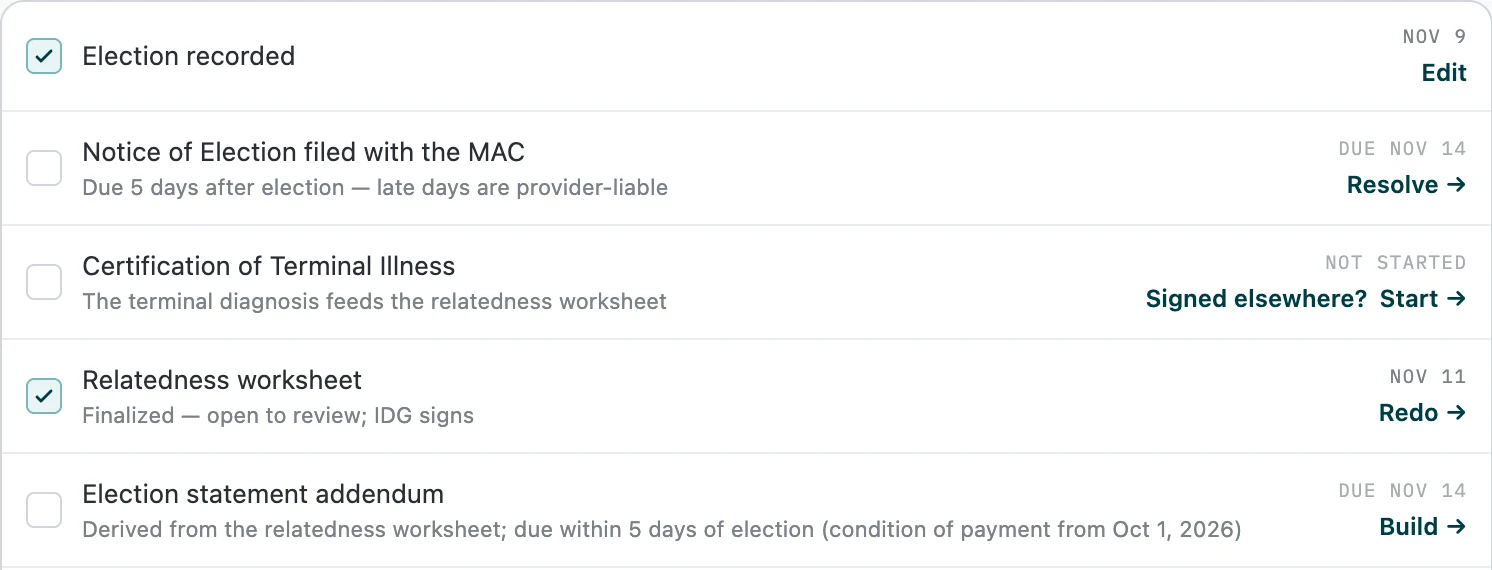
What it does not do is the clinical work behind each date. It will tell you the face-to-face window opens on April 8. The visit is still yours.
Check your own process
- One effective date. Is the election's effective date recorded once, in one place, and is that the date everything counts from?
- An owner for each clock. The notice is usually billing, the assessments nursing, the certification the physician. Who notices when one of them is at day four?
- Weekends. Calendar days include them. What happens to a Thursday admission?
- Transfers. Do you ask for the benefit period on every admission, before the first week is over?
- The 15-day gap. Pull five charts and count the days between documented reviews.
If you would like every patient's dates worked out for you, you can start a trial.
This post is general information about Medicare rules, not legal advice. The rules are in 42 C.F.R. Part 418 and the HOPE Guidance Manual.